
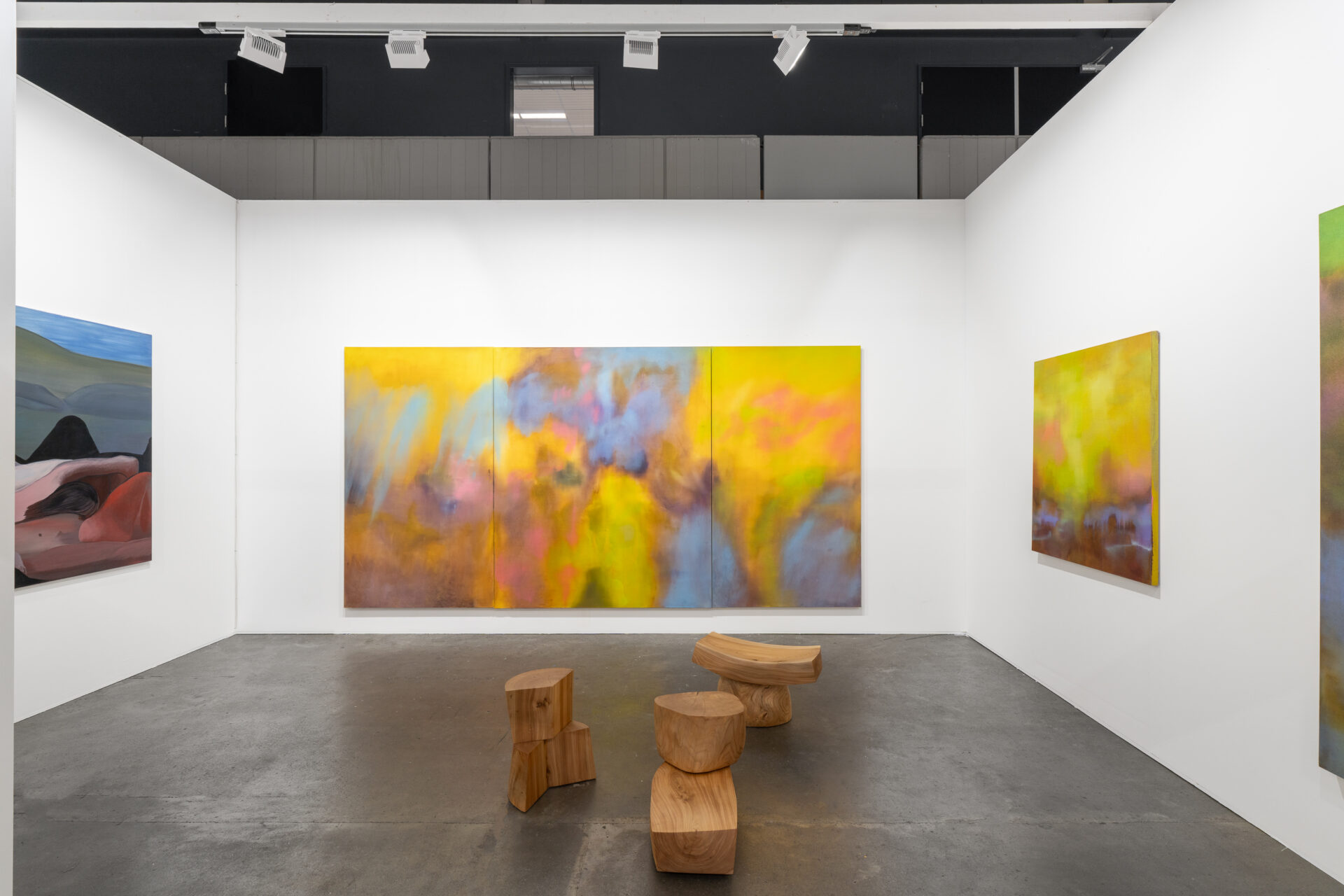
Size:
200 x 240 cm
Medium:
oil on linen
Year:
2026
oil on canvas
410×210 cm
William Farr (b. 1992, UK) is a British painter based in London.
Working in oil on linen, Farr employs a layered and time-intensive process in which pigment is
suspended, thinned, and reworked across multiple sessions. His paintings emerge through an iterative
practice of application and removal, allowing paint to behave less as substance and more as atmosphere. Surfaces shift with light and duration, resisting immediacy and fixed interpretation. Rather than functioning as expressive gesture, colour in Farr’s work operates as a condition -something to be inhabited rather than decoded.
Farr’s practice investigates painting as a site of inward attention, perceptual suspension, and the gradual
release of fixed forms of subjectivity. Drawing on the Romantic sublime and the legacy of Colour Field painting, his work proposes painting as a contemplative threshold: an ‘empty place’ in which discipline and intuition, control and surrender, coexist. The immersive quality of the paintings invites sustained looking, asking the viewer to remain with uncertainty and slowness, and to encounter perception itself as a temporal, embodied act.
Recent solo exhibitions include Dissolution (Homecoming Gallery, Amsterdam, 2026), Metanoia (Berntson Bhattacharjee, London, 2025), and Attachment (curated by Rubedo at Palazzo Cramer / GoLab, Milan, 2025). He received his MA in Painting from the Royal College of Art in 2024.
Size:
200 x 240 cm
Medium:
oil on linen
Year:
2026
All orders are typically processed and delivered within 15 business days. We cannot guarantee delivery times as processing times per artwork may vary depending on production technique.
Learn more about this artworks sizes, editions and prices
William Farr (b. 1992, UK) is a British painter based in London.
Working in oil on linen, Farr employs a layered and time-intensive process in which pigment is suspended, thinned, and reworked across multiple sessions. His paintings emerge through an iterative practice of application and removal, allowing paint to behave less as substance and more as atmosphere. Surfaces shift with light and duration, resisting immediacy and fixed interpretation. Rather than functioning as expressive gesture, colour in Farr’s work operates as a condition -something to be inhabited rather than decoded.
Farr’s practice investigates painting as a site of inward attention, perceptual suspension, and the gradual release of fixed forms of subjectivity. Drawing on the Romantic sublime and the legacy of Colour Field painting, his work proposes painting as a contemplative threshold: an ‘empty place’ in which discipline and intuition, control and surrender, coexist. The immersive quality of the paintings invites sustained looking, asking the viewer to remain with uncertainty and slowness, and to encounter perception itself as a temporal, embodied act.
Recent solo exhibitions include Dissolution (Homecoming Gallery, Amsterdam, 2026), Metanoia (Berntson Bhattacharjee, London, 2025), and Attachment (curated by Rubedo at Palazzo Cramer / GoLab, Milan, 2025). He received his MA in Painting from the Royal College of Art in 2024.
Squint, don’t think.
A soft perceptual overwhelm comes when viewing William Farr’s recent triptych, Dissolution 01 Anthropometrically scaled, there is an unwritten visceral invitation to lean in and push through the chiasmic boundary to their thin, shifting liminal surface.
Sit.
Farr’s great-grandmother chopped the legs off of the chair now used to view his paintings. This subversion of domestic scale evokes Van Gogh’s Chair (his abstraction of yellow, a key inspiration in the show).
Seated, squinting.
There exists a semiotic complication in writing about Farr’s work. Like a child lying on the grass and looking at it so closely that a scotoma – a blurry blindness – shrinks the universe into moving smudges of colour. It is a struggle to resist the mimetic urge to form objects or landscapes out of the surfaces; such links are possibly childish and reductive. Farr feels that these nonexistent clues could negate the viewer’s ability to step into autonomous space. These edges of light are contained only by the formalist dimensions of the stretchers. And yet they bleed.
Pulling in.
The sway of fixation towards something known. Pulling out. An abandonment into spatial expansiveness. A vital discourse between ecstasy and woozy. This repeated yellow; a sign of noetic enlightenment or delusion? Regardless it is impossible to let go, yet the works invite us to catch moments of disappearance. The essence, not definition in focus.
As the endless ‘bloembedden’ of Keukenhof birth an abundance of colour fields, the exhibition comes into being. These worlds coexist through a perennial erotic emergence, their vitality shared. At dusk – with or without psychoactive intervention – blossoms briefly appear to give back some of the light they have received. Unsurprisingly there is a haptic impulse when looking at this series, to grasp them before they vanish, yet they prove far more robust than their diaphanous surfaces suggest.
Do the sized stretchers vibrate as Farr works? There is an auto-cannibalistic rhythm to his process; a repeated dialectic of application and then erasure in an ode to Rauschenberg’s Erased De Kooning Drawing? Through this struggle, the paintings are continually made and then erased; their resolution and resilience flickering into existence.
Farr strives to strip the field of distractions, presenting these works as portals into shifting shapes, colours and light. It is human nature to make things out of passing clouds, yet any association of meaning is equally transitory and forgotten.
In Dissolution, there is a rupture of a sacred partnership. The dissonance between the intensity and clarity of passion evidenced by Farr’s being and the attempted disappearance act within the work. The concept of ego death framed as a return to connection or coupling to something other. Regardless there is an active aliveness in the paintings’ chromatic resolution.
These surfaces can never become tabulae rasae. Stains, traces and residual marks linger. The journey that Farr has taken through these three exhibitions is saturated with spiritual connotations. The titles thinly veiling mystical transitions: Metanoia, Detachment and Dissolution. This impression is further reified by Farr’s studio being in a former place of theosophical inquiry.
Wipe it all away, start again, and again.
Arriving at colours, the thin surfaces deceive. There is spirit in the superficial, this is not light work. The arduous application and removal of pigment and medium create a Sisyphean trance. Dissolution alludes to collapse, suspension, finish, recess, and cessation; all words with double meanings, yet also nomenclatures for the journey of the soul.
In Farr’s dissertation Queering Flowers, there is an image using these words;
‘I lost my path I left my trail when I left give back your hands’.
Reading these words, one can imagine a desire for self abandonment and attachment. A fixation for significance could be seen as a discomfort arising from being with the unknown. Just don’t stare.
by Merlin Massara, 2026
SHOWS
2026 | solo exhibition Dissolution, with Homecoming Gallery, Amsterdam, NL
2025 | solo exhibition Metanoia, with Berntson Bhattacharjee, London, UK
2025 | solo exhibition Attachment, curated by Rubedo at Palazzo Cramer / GoLab, Milan, IT
Working in oil on linen, William Farr is known for large-scale works that build and erase pigment repeatedly, creating thin, shifting surfaces caught between presence and disappearance. Farr's work resists fixed meaning, inviting viewers into an open perceptual experience rather than guiding them toward interpretation.
Stay up to date on fairs, pop-ups and latest book publishings.